Half of what you agreed with a client is on WhatsApp. The rest is in an inbox.
ExcelDisc Chat is one place for the conversations a business actually has. There is exactly
one thread per person — opened the first time either of you writes, kept by both of you,
searchable back to the first message. Groups have a door policy. And an offer reaches two
hundred clients as two hundred private messages, after each of them has agreed to receive it.
The table further down is the whole argument: twelve rows, three columns, and every row opens
into the part of the app behind it. Two of the rows go to WhatsApp and three go to email.
Those open too.
iPhone, Android and desktop. Sign in with a Google account — no phone number to give
out, and it installs from the browser rather than a store.
AK
Amina Khalid
online
Morning — did the shipment paperwork come through?08:41
Invoice‑4821.pdf
240 KB
Signed copy attached.08:43
AK
0:1208:44
Perfect. I’ll add you to the Kenya Clients list.08:45
Amina is typing…
Message
Where it goes wrong
Two tools, four failures, every week.
This is not a complaint about either. WhatsApp is a phone-book messenger and email is a
postal system. A client relationship is neither, so it ends up split across both.
The offer you send is the thing that gets you restricted.
Sending the same message to forty clients from your own number is the most useful thing you
could do with a messenger, and it is the one thing the platform is built to stop.
WhatsApp’s Terms of Service
prohibit using the service in ways that “involve sending illegal or impermissible
communications such as bulk messaging, auto-messaging, auto-dialing, and the like”, and
reserve the right to suspend an account for violating “the letter or spirit” of
those terms. Do it properly on the Business Platform instead and every marketing message
becomes a template Meta must approve, charged per delivered message.
The offer you email lands under Promotions.
Nothing bounces. Nothing tells you. It sits in a tab your client opens on a Sunday, if at all.
Gmail sorts incoming mail into categories by itself, and Google’s own definition of the
Promotions tab
is “deals, offers, and other promotional emails” — which is precisely what a
quotation with a discount on it looks like to a classifier. A bounce would at least be
information. This is silence that reads like being ignored.
Nobody can find what was actually agreed.
The quote went by email. The change of mind came on WhatsApp. The revised figure was a voice
note. Six months later neither of you can produce the sentence you both remember.
Gmail starts a new conversation
whenever the subject line changes, and splits any thread that passes 100 messages. WhatsApp
holds whatever that particular handset still has, which is why the answer to “can you
find it?” depends on whose phone you ask and whether they have changed it.
One Cc instead of Bcc and the client list is public.
It takes one keystroke, it cannot be recalled, and it is the kind of mistake that ends a
supplier relationship rather than starting a conversation about process.
The UK’s Information Commissioner
counts incorrect use of Bcc
“consistently within the top 10 non-cyber breaches, with nearly a thousand reported
since 2019”, and says outright that Bcc “is not enough on its own to properly
protect people’s personal information”.
The rest of this page answers those four: a live connection instead of store-and-forward,
permission recorded once per person instead of a gamble, one searchable history per relationship
instead of three, and delivery that is private by construction rather than by remembering to use
the right field.
Side by side
Twelve things a business needs doing, and how each one goes.
Five of these twelve go to WhatsApp or to email. They are here because a comparison that only
lists wins is not a comparison.
Best of the three Works, with a caveat Where it falls down
ExcelDisc Chat
WhatsApp
Business email
Getting a reply today
Instant, with read receipts
Instant
Queued, retried for days
Reaching someone new
Email address, or your link
Their phone number
Any address, no account
One message to many
Named lists, up to 500
Templates, approved first
Arrives under Promotions
Permission to send it
Asked and recorded once
Required, never collected
Yours to obtain and prove
What it costs to send
Nothing, and no approval
Per delivered message
Cheap; deliverability is work
Recipients seeing each other
Never — separate chats
Hidden too
One Cc and it is out
Announcements to a list
Channels; a count, no names
Channels
Reply-all
Deciding who joins a room
10 questions before approval
Approve, with nothing to go on
A Cc list that drifts
Finding something old
Server-side, every device
Only what this handset holds
Strong, if the thread held
Files
10 MB, no video
Comparable, takes video
25–35 MB
Encryption
Not end-to-end
End-to-end
TLS, readable at rest
Voice and video calls
None, deliberately
Voice and video
None
Every claim in the WhatsApp and email columns comes from a document published by WhatsApp, Meta,
Google, Microsoft, the ICO, the FTC or the internet standards themselves, and the ones
that carry weight are linked from the section below. Platform rules and prices change on their owners’ schedule
rather than ours — if you are deciding on the strength of a row, follow its source. Checked
August 2026.
Where the other two win outright. WhatsApp is end-to-end encrypted, it makes calls, and
your client already has it open — none of which is true here. Email reaches anyone alive with an
address, carries larger files, and is what retention and discovery tooling was built around. It
is also the layer this app stands on: you sign in with a Google account, and your contacts are
matched by their email addresses. We are not neutral about email and it would be dishonest to
pretend to be.
The app itself
What those rows look like in practice.
Captures of the running app, with invented clients — not mock-ups.
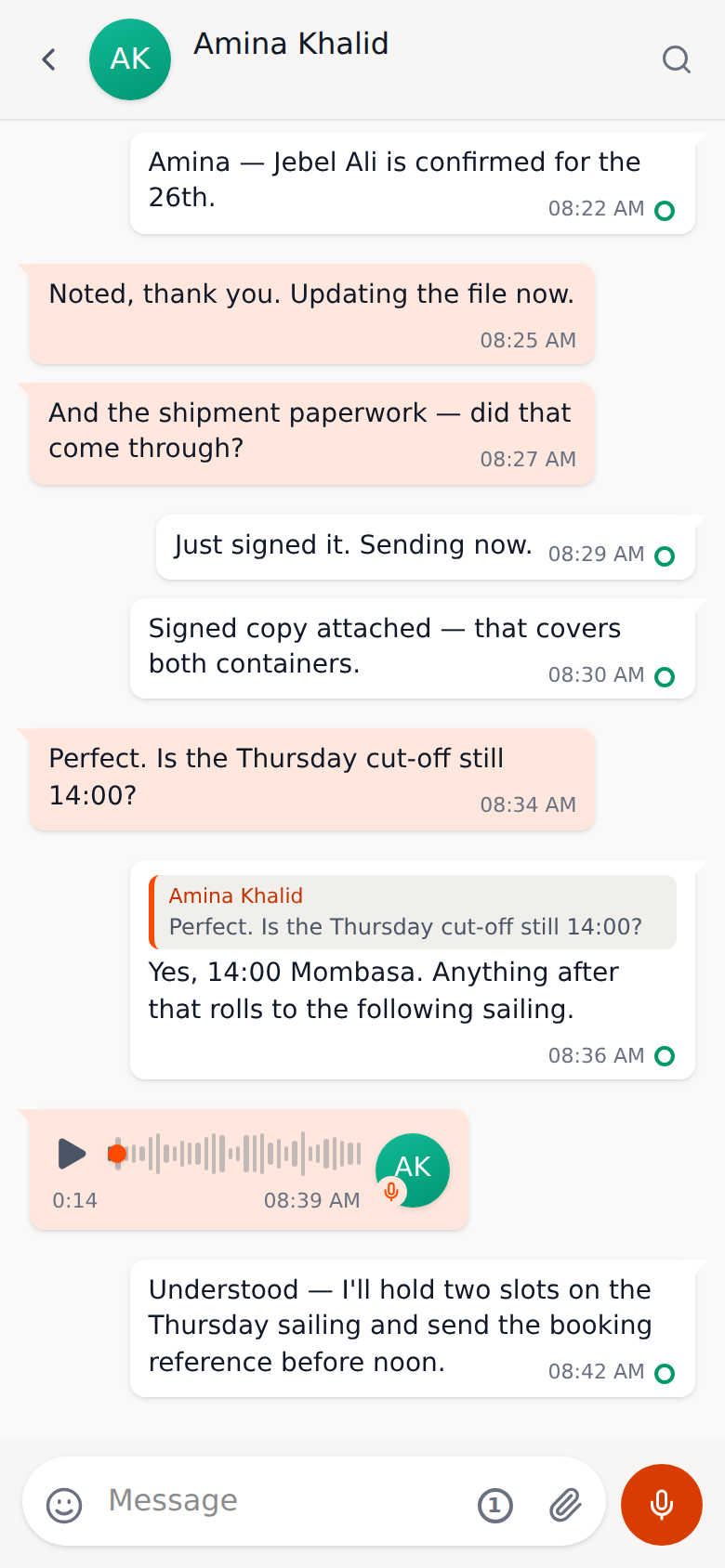
One thread per person. The ring on your own messages fills as they travel — half once
the server has it, whole once it has reached their phone, green once it has been read. A
reply quotes what it answers, and a voice note plays where it was sent.
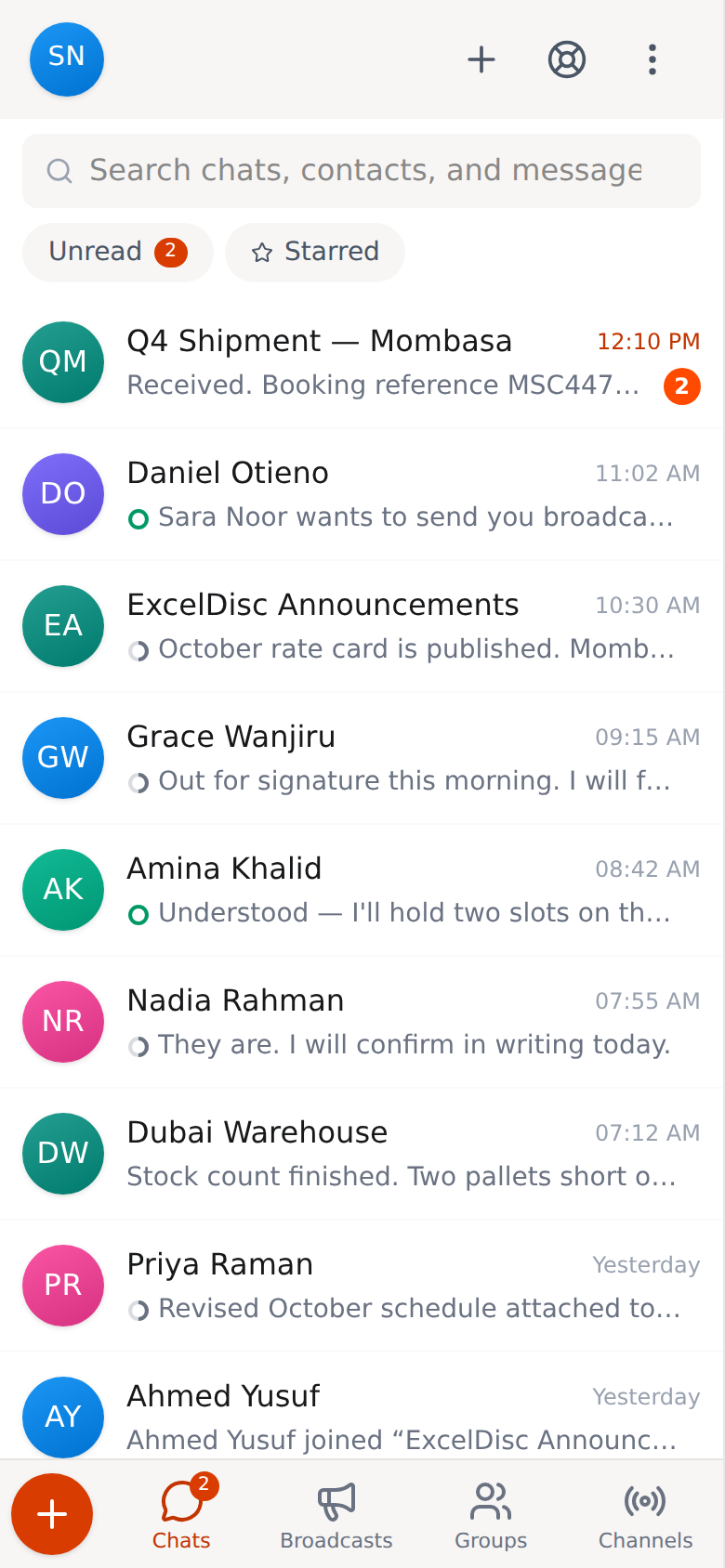
The chat list, on an iPhone. Unread counts sit on the row, the same ring reports your own
last message, and the bar along the bottom is groups, channels and broadcasts.
One offer, two hundred clients
The same message, three channels, three different obstacle courses.
What each one actually makes you do before a client reads a word of it.
Here
one offer, 200 clients
Group contacts into a named list
Send. Anyone who has not agreed gets a request, not the offer
They accept or decline — once, for good
Every later send lands as an ordinary private message
Delivered. No approval, no per-message charge, and no recipient sees another.
On WhatsApp
the Business Platform
Write it as a template
Meta must approve it before it can be sent
Charged per delivered message, by country and category
Volume is tiered — a new portfolio starts at 250 a day
Maybe delivered. Templates can be paused for low read rates, and marketing messages may be limited per user.
None of this gets you out of the law, and it is not meant to. The UK regulator’s definition of
“electronic mail”
covers direct messages too, so the consent rules that govern a mailing list follow you into a
messenger. The GDPR
wants consent you can demonstrate; CAN-SPAM
has no business-to-business exception. That is an argument for the tool recording consent rather
than you remembering it — not for skipping it.
Rows 04 and 06
What happens when you press Send.
Six steps, in the order the server performs them. None of it is a setting you have to go and
find, and the answer is recorded once per person — not per list, and not per message.
ExcelDisc ChatBuilt into the send. The first one asks, and holds the offer back until they answer. A refusal is durable.
WhatsAppRequired before you message anyone: Meta's Business Messaging Policy asks for opt-in confirming the person wishes to receive your messages. Nothing in the app collects it or keeps the record.
Business emailYours to obtain, prove and honour. The GDPR requires you to be able to demonstrate consent; CAN-SPAM applies to business-to-business mail with no exception.
ExcelDisc ChatNever, by construction. Each copy is its own one-to-one chat, and nobody learns the size of the send.
WhatsAppNo — broadcast hides them too.
Business emailOne Cc where you meant Bcc exposes the whole list, and it cannot be recalled.
1
A list is not a permission.
You group contacts into named lists — Kenya Clients, Suppliers, Retail. A list can only hold people already saved in your contacts, so it can never be pointed at a stranger, and building one contacts nobody. Who you intend to message and who has agreed to hear from you are two separate records. That is why adding someone to a second list never asks them again, and why deleting a list takes away the grouping and nobody's consent.
2
The send skips before it delivers.
Press Send and the server walks the list one person at a time. It skips you. It skips anyone either of you has blocked, in either direction. It skips anyone who has declined you before. It skips anyone still holding an unanswered request. Only what is left of the list gets anything at all.
3
First contact is a question, not the offer.
Someone who has never agreed receives a card in the ordinary one-to-one chat they already have with you: your name, and Accept or Decline. The text you were broadcasting is not attached to it, is not written into their conversation, and does not appear in the notification. They see who is asking before they decide anything.
4
They answer once, and are never asked twice.
Accept, and the agreement is recorded against you as a sender rather than against the list, so it holds for every list you will ever build. Decline, and you are skipped from then on — no chat, no message, no notification — and you cannot ask again. Leave it unanswered and they are skipped too. One request is the most anyone ever gets from you.
5
Delivery is an ordinary private message.
Once someone has agreed, each broadcast is written into your one-to-one chat with them and labelled “Broadcast” on the message itself, so nobody is misled into thinking they were written to personally. It arrives with an ordinary notification, in the conversation you already share. They can reply and then you are simply talking, in the same thread as everything else you have ever said to each other. No recipient sees another, and none of them learns how many there were.
6
Afterwards there is a report.
Every press of Send is kept: what you wrote, which list it went to, and a line per recipient — delivered, asked, still awaiting an answer, declined, or unavailable. The read count is not frozen at the moment you sent; it is worked out from when each person last opened their chat with you, so it keeps climbing for days as people catch up. "Unavailable" is what a block looks like from your side, and the report deliberately never tells you which direction it went.
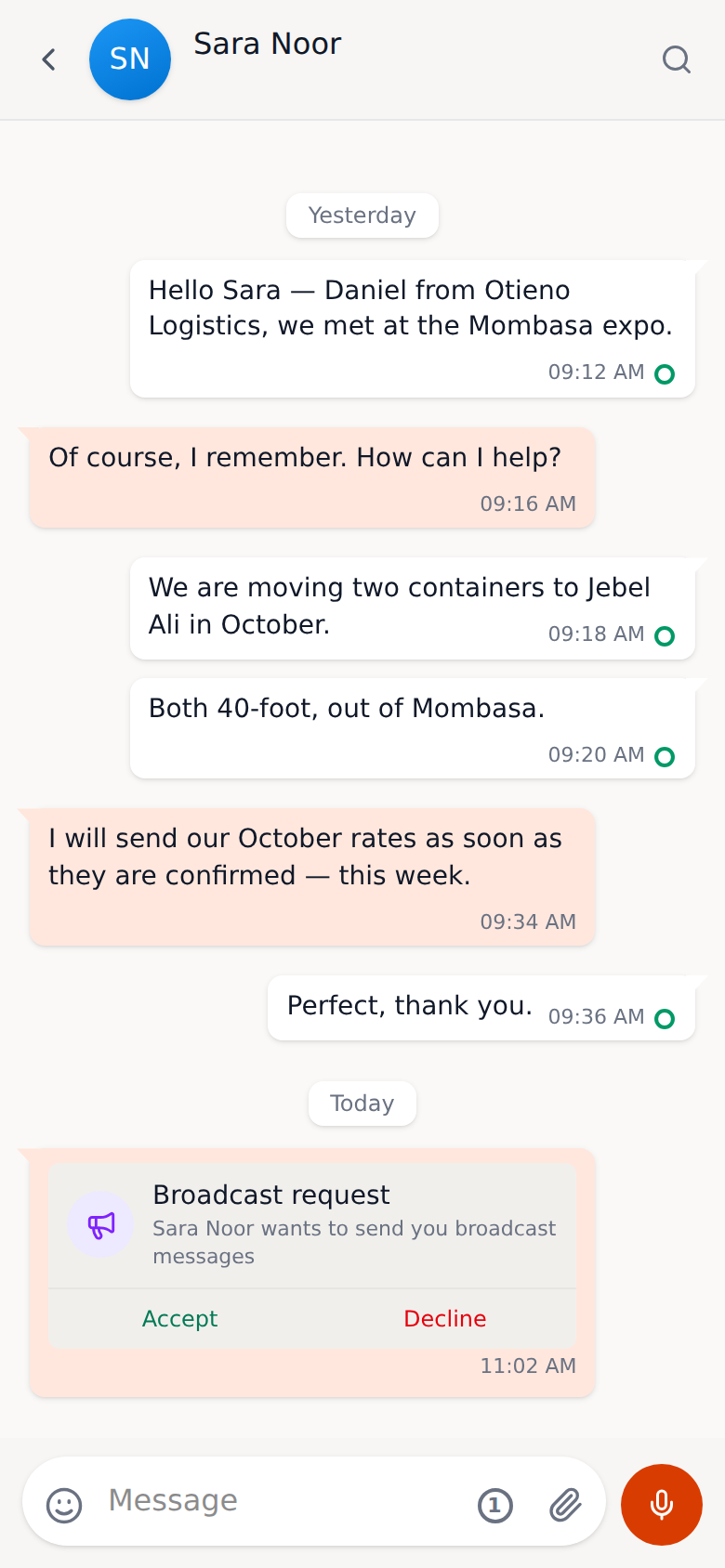
What a client sees the first time you broadcast to them. Note what is not in it: the offer
itself. It is not in the notification either.
What the person receiving it can do
Accept, and change their mind later. Agreeing once is not permanent, and you are told either way — in wording that separates answering a request from stopping months later.
Decline, and be left alone. It holds against you as a sender, for every list you will ever build, and you cannot ask again.
Mute, and have nothing said about it. Your broadcasts keep arriving, with no sound, no banner and no notification. You are never told.
Muting the broadcasts is not muting the person. Their ordinary messages notify exactly as before.
The mute is invisible to the sender deliberately: a mute they could see would cost the recipient
as much socially as a refusal, and then nobody would use the polite option. The app says as much
to the recipient, in these words — “Muting keeps their messages arriving without alerting
you, and is not shown to them. Stopping is — they are told you no longer want their
broadcasts.”
Three things to know before you plan around this. A broadcast is text, up to 4,000
characters — there is no way to broadcast a photo, a document or a voice note, and if that is what
you need it is an ordinary message to each person, or an email. One send addresses up to 500
people. And “delivered” in the report means the message was written into that
person’s conversation, not that a particular handset rang. No product can truthfully promise
the second thing, and the ones that imply it are describing the first.
Rows 11 and 12
What it does not do.
Some of these you have already met in the table above; the rest are things nobody would
have asked about until it was too late to matter. Every one of them is either deliberate or unfinished,
and none should be a surprise to you in a month.
Not end-to-end encrypted.
Messages travel over TLS and the copy cached on your device is encrypted at rest with a key
that cannot be read out of the browser, even by script injected into the page. Neither of
those is end-to-end encryption and we will not call it that. The server holds every message
readable — which is the trade: it is what lets search work across every device you own, and
what makes a reported message something a person can actually look at. If a conversation
needs to be readable by nobody but the two of you, this is the wrong place for it and
WhatsApp or Signal is the right one.
No voice or video calls.
There were, for a day. They were removed in August 2026 and nothing call-related is left
anywhere in the app. This is for written work — the thread, the file, the thing you need to
find again in March — and the absence is the point rather than a gap on a roadmap.
No video, and 10 MB a file.
Images, PDFs, Word, Excel, PowerPoint, text, CSV, ZIP and voice notes, one file per message.
Not video, and not a 40 MB catalogue. That is still what email is for, and email is
better at it.
No directory, and nothing that invites a stranger.
Nobody can look you up. You add a contact by their email address, or by following a link you
handed out. The other side of that: the person must already have an account, because there is
no invitation by SMS and none by email — the app sends no email of any kind.
No export, and deleting your account does not unsend you.
There is no download-your-data button today. Deleting your account clears your contacts,
memberships, blocks and picture and stops every session immediately, but the messages you
sent stay in other people’s conversations with your name detached from them. Quietly
rewriting somebody else’s record of a conversation is not a feature, it is a liability.
Delivery status is a signal, not a receipt.
Sent, delivered and read are worked out at the moment you ask, from who is connected right
then, rather than stored and stamped. Useful for knowing whether to ring someone. Not
something to produce in a dispute.
Getting started
Sign in, install it, add the people you already talk to.
Sign in with Google
No phone number, no SIM, no password to invent, and no form to fill in. Your Google profile
picture comes across the first time, copied onto this server rather than linked from
Google’s — so nobody who looks at your picture is disclosed to them. A picture you
choose in the app always outranks it.
Add a company, an address and a WhatsApp number if you want clients to see them; all optional
except your name. Your email address is fixed afterwards, because it is what Google
authenticates and what your contacts are matched on.
Put it on the home screen, and allow notifications
iPhone and iPad: Safari, then Share, then Add to Home Screen. That step is not
optional there — Apple gives a browser tab no way to receive a notification at all, so on iOS
installing is what turns notifications on.
Android: Chrome offers Install app by itself, and Add to Home screen is still in the ⋮
menu if you dismiss it. Notifications work either way.
Windows, Mac and Linux: install from the icon at the end of the address bar in Chrome
or Edge, or just leave it in a tab.
The app asks for notifications behind a button you tap, never on load, because a browser gives
it exactly one chance and spending it while nobody is looking wastes it for good.
Add the people you already talk to
By email address, one at a time, once they have an account. Or import from your phone’s
address book — matched against existing accounts by email or by the WhatsApp number on a
profile, and keeping nothing about anybody who is not already a user. Or send them your link
and let them open the conversation from their side, which saves you both as contacts either
way.
The people-picker offers everyone you already share a conversation with, not only your saved
contacts, so meeting someone in a group is enough.
You also get a link of your own.chat.exceldisc.com/c/yourname opens a chat
with you — put it in an email signature, on a card, on a website. Change the name and the old link
stops working, which is how something printed on five hundred business cards can be withdrawn.
Today it installs from the browser rather than from a store, which is why a fix reaches
your phone the day it is written instead of after a review queue, and why there is no 200 MB
update to sit through on mobile data.
Keep what each one is good at.
Email for the quote, the contract, the notice that has to carry your address, and anyone you have
never met. WhatsApp for the client who will not move and should not be asked to.
This for the rest — and to find out whether it is worth it, start with one client. Open it, add
the person you have emailed twice this week, and move that one thread across. In a month you will
know whether it was easier to find than the two places it used to live. That is the whole test,
and it costs you one conversation.